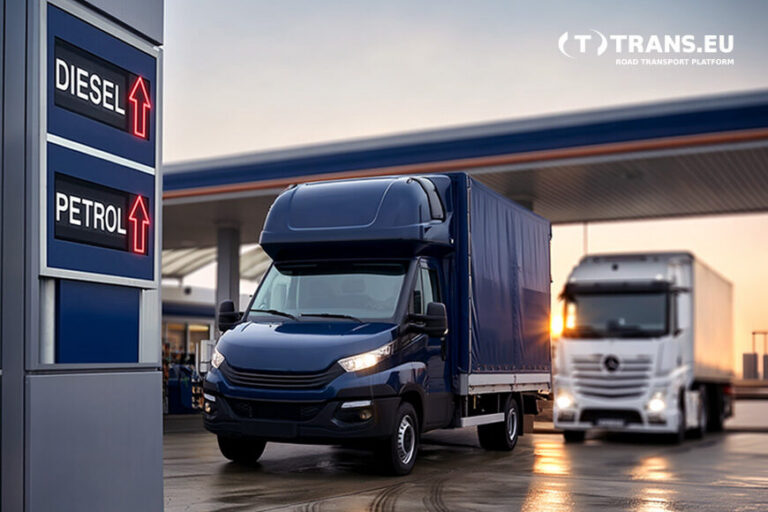
Across Europe, carriers are considering ways to manage the rising fuel prices. According to a Transport & Environment study, the current situation could cost European drivers an additional €150 million every single day, a reminder of just how exposed the industry remains to global shocks.
In the Netherlands, some drivers are reducing speed to cut fuel consumption, according to the Dutch transport association TLN, quoted by Trans.eu. In Portugal, governments are adjusting excise duties to soften the blow. In Central and Eastern Europe, lower prices are attracting cross-border refueling, creating fuel tourism and even local shortages. Some governments have moved quickly to shield drivers from fuel price shocks.
Everyone is trying to adapt.But none of these solutions change the core problem.
Fuel prices are rising fast. And every empty kilometer is now more expensive than it was just weeks ago.
How rising fuel prices increase empty kilometers costs for carriers
Fuel has always been one of the biggest costs in transport. Today, it is becoming the most unpredictable one.
When prices increase by €0.20–€0.30 per liter, the impact is immediate. A standard long-haul trip can cost hundreds of euros more in fuel alone. And if part of that route is empty, that cost comes directly out of your margin.
This is where many carriers are losing money without realizing it.
You are not just paying more for fuel. You are paying more for every kilometer that doesn’t generate revenue.
Why contract rates cannot keep up with fuel price increases
Many contract rates are not adjusting fast enough to reflect current fuel costs.
Fuel prices change weekly, sometimes daily, while contract prices stay fixed. The result is simple. Costs increase immediately, revenues stay the same, and margins disappear.
This is why more carriers are turning to the spot market. On the spot market, rates reflect real-time conditions. You can react faster, find better-paying loads, and avoid being locked into underpriced contracts.
Fuel price changes across Europe and their impact on carriers
Fuel prices are rising across all European markets, but not at the same pace.
In Germany and the Netherlands, diesel prices have increased sharply, by as much as €0.40–€0.50 per liter within weeks. These increases are fully market-driven.
In Poland, prices have also risen significantly, although part of the increase has been absorbed through reduced margins. In Hungary, prices were artificially capped, which hides the real cost pressure rather than removing it.
Across Central and Eastern Europe, fuel remains cheaper overall compared to Western countries, which is already influencing where carriers choose to refuel and operate.
The result is a fragmented market where costs are rising everywhere, but not evenly. This directly affects route planning, pricing, and load selection.
Why finding return loads is critical to reduce empty kilometers
In this environment, efficiency alone is not enough. Reducing empty kilometers is now one of the fastest ways to protect your margin. Carriers who consistently find return loads, avoid empty runs, and react quickly to changing rates are in a much stronger position.
Even occasional empty runs now cost significantly more than they did just a few months ago.
How a freight exchange helps carriers find loads faster and increase profitability
Access to a large, active network makes a real difference when the market is volatile.
With Trans.eu, carriers can find return loads faster across Europe, reduce empty kilometers, and access current spot rates instead of relying only on fixed contracts. This allows you to choose better-paying loads and keep your trucks moving.
Instead of waiting or driving empty, you can fill gaps immediately and improve fleet utilization.
How to protect cash flow when fuel prices are rising
Rising fuel costs are not just an operational issue. They also affect cash flow.
Carriers often pay for fuel upfront while waiting 30, 60, or even 90 days for payment. When fuel prices increase, this gap becomes more difficult to manage.
With SafePay and integrated financial services on Trans.eu, carriers can reduce payment risk, secure faster payments, and avoid liquidity gaps caused by rising fuel costs.
In a volatile market, cash flow stability becomes just as important as finding loads.
Reduce empty kilometers and stay profitable in a high fuel cost market
Fuel prices are outside your control. Empty kilometers are not. Every unplanned empty route costs more today than it did last month. Carriers who react faster, use the spot market, and secure return loads will protect their margins.
Those who don’t will feel the impact first.
Find loads faster and reduce empty kilometers on Trans.eu.
FAQ: Fuel prices, empty kilometers, and finding loads
Why are empty kilometers more expensive now?
Higher fuel prices mean that every kilometer driven without cargo generates higher costs. Empty runs now have a much greater impact on overall profitability.
How can carriers reduce empty kilometers?
Carriers can reduce empty kilometers by using freight exchanges to find return loads faster, plan routes more efficiently, and react to available capacity in real time.
Is the spot market better than contracts during fuel price increases?
Yes. Spot rates reflect current market conditions, including fuel costs, which allows carriers to find better-paying loads compared to fixed contracts.
How can carriers improve cash flow during fuel price volatility?
Using solutions like SafePay and other integrated financial services on Trans.eu helps carriers reduce risk during these uncertain times.